Friday, 11 March 2016

A View From the Rock - Steelmen on Tour


The photo is of the motley crew congregating in the Rock before last Saturdays adventure to FC United in Manchester. It had been decided after some debate throughout the week leading up to the game that the M1 was the best option following a discussion Dan had had with his lorry driving brother Harry. Fair enough, you bow to these legends of the road. We were going in convoy with Pat McMahon in the vanguard, accompanied by Dan Coyle, Wilf Wilson and myself. Gordon Edgar was following, his team consisting of Brian Joiner, Fish and JC. The big feller (Gordon) had been preening beforehand about his new car but was somewhat disenchanted when he told us later at the Dog and Partridge, a lovely Inn high on the Moors, that his fuel gauge wasn't working! Questions were asked about where he purchased the vehicle, ‘not from a car salesman in the Rock by any chance Gordon?’ 

A nice snack and a pint was enjoyed in the Dog, nice people running the place too. Dan Coyle was his usual insouciant self, almost joyous, asking the landlady if she would be kind enough to place his Kit Kat, which was melting in his rucksack, in her fridge to harden for a bit. 
That she did was testimony to what pleasant people they are in the north of England. “Of course” she said with a lovely smile to a delighted Dan, “no problem”.
Half an hour later while driving through the wonderfully named village of Tintwhistle Dan blurted out from the back of the car; “My Kit Kat!” Pat nearly put his foot through the floor as he slammed his brakes!  I wouldn’t say Dan was distraught at the possible loss of his Kit Kat, too strong a word, but we pacified him by telling him we would head back to the Dug after the game to retrieve it and for a post match pint while we were there. 

The M1 turned out to be a decent route, as rumours before kick off confirmed. The supporters bus which left the White Hart had been delayed on the awful M6 due to the normal congestion and delays and didn’t arrive at FC until well after the kick off. 

The trip to FC United was certainly an experience. We had been warned beforehand that the welcome at Moston, Manchester would be hostile, unfriendly. The supporters were arrogant, belligerent. Couldn’t have been further from the truth. Everyone was made to feel welcome. 
They have a wonderful ground, great facilities and bags of room for expansion. A club on its way up the pyramid ladder, no doubt about it. 

The atmosphere inside their stadium was electric and the din their fans make has to be heard to be believed. Some cracking songs they sing as well. What was amazing was how many of their ‘old yins’ were singing along with gusto too. They say a crowd like that is worth a goal start to their team. An old cliche it may be, even if Corby defied that logic last Saturday. It was a battle of the two promoted Champion sides from last season and it was a good scrap. FC charged out of their blocks from the kick off and tore into the Steelmen, hammering away towards the hordes of their fans in that huge intimidating stand behind the goal. 
It must haven discerning for keeper Paul Walker but a good experience never the less and he was his usual safe and solid self. 

It didn’t look too promising with Corby’s goal under siege but the defence held firm with Ben Milnes and Cleveland Taylor both tireless terriers in front of the back four providing some excellent cover. As the game progressed FC’s desire began to wane, passes began to stray, frustration crept in as Corby’s defence held firm. There was only occasional forays into the FC half but it was enough to make FC feel uncomfortable about a counter attack.

Second half was much the same with the Steelmen more prominent in attack but it was a stalemate. The noise intensified though. The 3,000 odd fans sang even louder. Both sides were going for the winner, one goal would surely be enough, and unfortunately for us, it went to the home side, with five minutes left on the clock. A scrappy effort it was too but they all count. The Corby team and our fans, must have been well over a hundred had travelled, were deflated. Home fans were gracious, shaking our hands and wishing us well and a safe trip home. The banter during the game had been great. 
A sickening blow and ultimately disappointing result, Tommy Wright mustn’t lose heart, this was by far the best his team had played this season. Suddenly it looked like the team started to believe that they do belong in this division, we can hold our own with the ‘big money’ sides.

FC are a club going places, as long as they can hold on to their core of ‘disgruntled’ Man Utd fans, as Pat McMahon opined. As their songs about Busby and the George Best era intimated, they have fallen out of love with their parent club and premiership football in general. The sky high admission prices, the all seating arenas, the hype, the absurd wages..haven’t we all had enough of this? United’s goalkeeper David De Gea epitomised the phoney and sanctimonious state of the game at the higher level this week. Denied a transfer to Real Madrid and sulking after months of courting the Spanish giants, all of a sudden, when it’s clear it wasn’t going to happen, he’s ‘delighted’ to be staying at Old Trafford after all, no doubt persuaded by a four year deal believed to be worth around £200,000 a week. OK, you wouldn’t turn it down either but you can understand the disillusionment of football fans who follow these clubs. And we are supposed to idolise these people? 

Getting back to matters nearer home at Steel Park. There has been a lot of wailing this season, regarding the style of play the Steelmen have been serving up and only the other week, Tommy Wright’s admission that he gets frustrated and doesn’t want to watch the style of football of lumping the ball up front all the time, was refreshing. Tom’s on the same wavelength as most of us punters even if Pat McMahon claims he over hears us sitting in the stand whinging! The former Corby Radio presenter is vociferous and often emotional. 

Having said all this its great being in this league and it will take time to adapt to this higher level of football. Quite simply there’s a few clubs who are full-time, bigger clubs with bigger fan bases, hence more money so personally I reckon we should all appreciate what we have and keep the faith with Tommy and the board and that we will continue to progress. Takes time, and money, chaps.

Worcester City are our opponents today, another club we have done many a battle with over the years. They were one of the first teams I remember watching at Occupation Road when I was a kid. There was great excitement at the inclusion of former Manchester City and Welsh international captain Roy Paul playing for them at the time. 

Don’t remember much about the game, to tell you the truth. At the age of 8 I was more interested in playing ‘tig' and chasing around with my mates, probably annoying the older fans! Until there was a penalty or something! 


Happy days!


Sunday, 20 April 2014

Jim Fotheringham


Jim Fotheringham

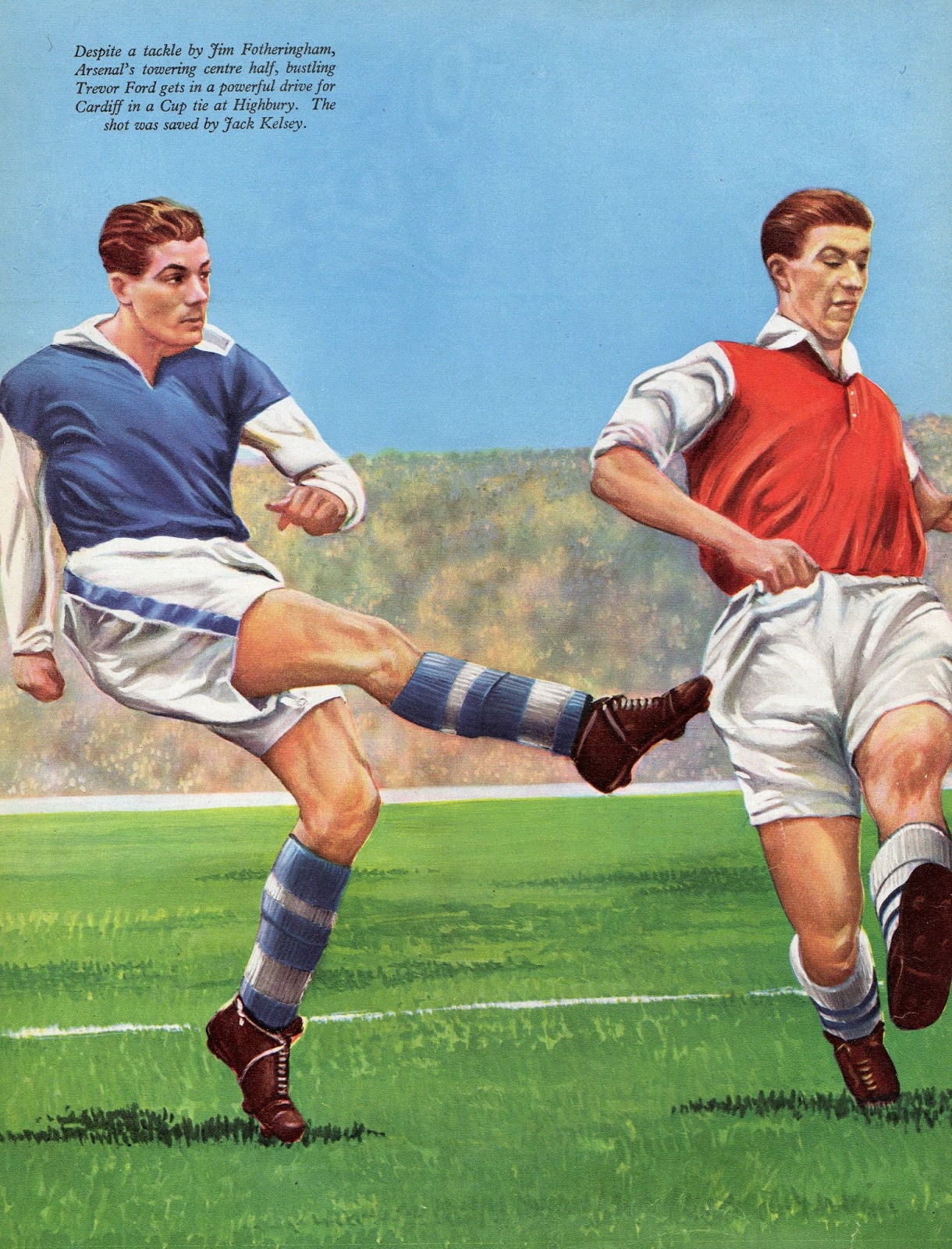
There have been many local lads to have broken into the big time but not many will be aware of who was the first. Back in the 1950s, former Corby Boys School player Jim Fotheringham was making a name for himself at centre half playing for Arsenal. He did in fact play for Arsenal against Manchester United the Saturday before United's ill fated trip to Yugoslavia and the Munich air crash. In 1955 Jim was featured in the July edition of the Charles Buchan Football Monthly. Here is his story;

'My Arsenal pals who have more soccer service in years than I have in months have often told me that the game a player never forgets is his first league match. I fully endorse that now, especially as in my case the first league problem that I had as a centre half, I had to deal with a fellow in a number 9 shirt named Nat Lofthouse. My second senior outing was against a Russian side in a match that had been lifted from the sports page to the front page - with the knowledge that millions were looking on through TV.'
It all added up to quite an opening for a teenage Scot. 'That was some week for me, last November. It began with a message to report to Mr. Whittaker's office on the Wednesday before our game with Bolton at Burnden Park. The boss told me I would be playing, also that I was being given early notice to get used to the idea and so stave off last minute nerves. But only when he wished me luck did the news really sink in. Nervous? I took it all very calmly - on Wednesday. On Thursday, thinking about the coming ordeal, I hardly ate anything! But by Saturday I felt quite composed. Nat Lofthouse was a great sport and I thoroughly enjoyed our first meeting. We got a much needed point in a 2-2 draw. Nat didn't score and it was this as much as anything that brought me to the end of the match very much relieved. I don't claim to be without nerves and I suppose the thoughts of playing against Spartak three days later should have been enough to worry anybody. But I kidded myself into thinking that it was just another game, despite the trimmings that were being woven around it. Honestly, I couldn't get over excited about the match. I suppose that is why I went out to have what I feel is my best game so far.
We Arsenal players tried all we knew to wipe out the memory of that 5-0 beating by Moscow Dynamo a month earlier. Maybe if we had got that second half penalty for a foul on Arthur Milton our right winger, we would have made it a draw. But though we went don 2-1 we all knew that we had done something to atone partially at least, for the Moscow beating.
For Arsenal was a grand team that night. In all modesty we can claim to have blown up the theories that Spartak were world beaters - Wolves later confirmed the point. That first week of mine is, naturally, the high spot in a modest career that has yet to stretch to a full season. But there was another week when it seemed that things might work out in rather hectic fashion for me. Looking back now I am rather frightened at the thought that my first big game might have been at Wembley in the Cup Final. Here are the facts; Three years ago Arsenal, due to meet Newcastle at Wembley, had the unluckiest bunch of injuries a club could have. Jimmy Logie and Doug Lishman were hospital cases and Ray Daniel our centre half, had a broken wrist in plaster and was very doubtful. I was reserve centre half, but right half Arthur Shaw-with much more experience- was given a game at centre half I case he had to take Ray's place. And Arthur also broke an arm. I had read in the newspapers that Arsenal might have to call on a young unknown in the Final. His name was Jim Fotheringham, and those reports made me very nervous. I doubt if I was seriously considered at the time, but Arthur’s injury made the situation even more desperate. Perhaps I solved it. That Saturday before the Cup Final I fell against our goalpost in trying to head away a corner. I caught the bottom of my spine and my legs became paralysed. They had to carry me off and I spent the next week in hospital.
But for my football I would have followed father into his trade as an engineer. My father came to Corby, Northants - 'Little Scotland' they call it, when I was eighteen months old. Many people are surprised at my Scottish accent when I tell them I have been in England so long - but Corby and thousands of exiled Scots explains that. Like most kids it was Rangers for me in the early days - even at some 400 miles range. Too busy playing; I saw little senior football as a youngster. But in Scotland on holidays I usually managed to see a game or two there, and big Frank Brennan was my favourite. He was then playing for Airdrie.

Big Jim Boys Club Days

My school games were played in the Samuel Lloyd School side; I was a left back then. Than came a move on to Corby Technical College and a change to centre half. I also represented Northampton Youth and was thrilled at the news that Sunderland and Leicester scouts were watching me. But before then came a chance for me, a Scot, to play for England schoolboys. I was picked for the South team to meet the North in a trial at Oxford. A few days before the game I went down with flu, but scared that I would miss my chance, I pretended to be better on the day. I made a real hash of things and bang went my cap. Strange, something like that almost happened to me on another occasion when I had my heart set on a game. I got the chance to play for the Army against Scotland at Hampden Park, during my service days. It was a wonderful thrill- until a troublesome boil on the face almost closed my left eye. I had daily penicillin injections, but it was no where near right on the day and again I had to pretend that I was much better than I really was. But who wouldn't have done the same in my place? We lost 2-1, but I had the privilege and pleasure of meeting fellows like George Young, Tommy Ring and Bobby Johnstone that afternoon.
My father, to my surprise, would not hear of trials at either Sunderland or Leicester for me. Much later I found out that he had his eyes and his hopes on a London club for me. An Arsenal scout was the first to enter our sitting room, and, in 1949, I was off to Highbury.
So keen was I, to make good that I spent a fortnight’s holiday there in order to be really fit for my test. I was determined not to let my father or myself down. My first game was against Leyton Orient in the London Mid-Week League. I was then 16. Now, at 6ft 3", they tell me I’m the tallest player in the game. Well, it's handy, to say the least, when the ball is in the air. I have had the best coaching from great players and great colleagues like Alf Field and Leslie Compton - and Tommy Lawton has been long suffering and a model of patience in teaching me how best to head a ball. And Arsenal? Even to a football rookie like me it is so obviously the best club in the world!'

Jim Fotheringham was selected for the Scotland World Cup squad in 1958 and later signed for Hearts for £12,000. Returning south he joined Northampton Town and broke his leg which sadly, was the end of his career. Jim spent three months coaching the Libyan national side in 1961 for the Arab Olympic Games. Turning his back of football, Jim took a job in the steelworks and died in Corby at the age of 44 in 1977.


Saturday, 21 December 2013

Fifty Years Ago This Week...November 1963

Corby v Dover Nov 9 2013

Jimmy Stanley heads wide against Bristol City in the F.A.Cup 1st Round at Occupation Road 1963

The world was stunned with the assassination of American President John F Kennedy, gunned down in Dallas, Texas. Conspiracy theorists have had a field day ever since over who really killed JFK. This was at the height of the so-called 'Cold War', East verses West, Russia verses the United States, CND marches, Soviet spies. Doom merchants predicted we were staring into the abyss of World War 3. Suddenly the world seemed a frightening place to be. "Where were you when you heard the news?" became the question generations would ask each other whenever the event was recalled.
Back in Corby, Tommy Hadden had other events on his mind. The manager of the Steelmen had his own spies out whilst attempting to plot the downfall of Third Division Bristol City in the F.A.Cup 1st Round Proper at Occupation Road. "Nothing to beat" Tommy was told, "this lot are cack". City may have been on an eleven match unbeaten run but Tommy was confident. "We too are on a ten match unbeaten run." He didn't go as far to say that 'we can shoot them down' but did say in his programme notes; "However good City are, I feel it is not beyond us to at least get a draw, our lads have proved as much against the glamorous Chelmsford City side." Which must have had the Bristol supporters quaking in their boots.
The Bristol City tie had the town buzzing with excitement. Programmes and rosettes adorned with 'Up The Steelmen!' were being sold in all the town pubs and clubs a week before the game. Schools were suddenly finding themselves short of toilet rolls as they were pilfered to be used as streamers at the game. Rattles were being oiled. Over 6,000 spectators jammed the roads with cars around the ground; Occupation Road resembled an early version of the M25. Non football fans on the 289 bus from the steelworks were less than enamored as it crawled through the traffic after the 6 to 2 shift. "Hurry up driver, the pubs shut at half two!" cried irate and gasping for a pint steelworkers.
A distraction from the excitement enveloping the town was provided with the announcement of the Dartford Tunnel being opened this week, the first episode of Dr Who being broadcast on BBC, 'With The Beatles' being released prior to the band departing on their first tour of the States and world domination. This was also the week that saw Gerry and the Pacemakers sitting proudly at the top of the record charts with a record that would be adopted by the supporters of their home town team Liverpool F.C and become the club's national anthem 'You'll Never Walk Alone'.
Steelmen fans had their own anthem, 'Ye Canny Shuv Yer Grannie Aff A Bus!"

The Corby team showed one change from their regular line up with forward Bobby Laverick sitting the game out due to suspension following a sending off at Trowbridge a month before the cup game. It was a blow without a doubt; Laverick had been around for a long time playing for the likes of Everton, Chelsea and Brighton. His experience would have been invaluable. However as one door closes, another one opens they say and stepping into the breach was local lad Jimmy Stanley who had already caught the attention of league scouts for Leicester City and Bolton Wanderers. Bristol City were led out by former England international centre forward John Atyeo, a big strapping guy that must have seemed a daunting task for Corby's centre half Barry Parsons. Not that Barry lost much sleep over the prospect; he was one of the most laid back players you could meet. Alongside him in defence was his mate, the tireless John Rennie. The two of them were stalwarts in the Corby side and according to their pal and still Corby supporter, George Bradshaw, 'the Raven' also, for over a decade. George maintains to this day that after a game at Occupation Road, the two of them would be in the Raven bar before the supporters! The Raven, apparently, was a favourite haunt for the Corby Town players, a handy drinking hole around the corner from the ground where they could chew the fat after games, and quite often, before the games! Hughie Curran the shining star of the Corby team who moved onto greener pastures and won Scotland caps whilst with Wolves was in the bar arguing with regulars John Black and Willie Ross the night before. John said Curran was half blootered and told him he should be at home resting. Curran told them to bog off, or words to that affect!

The atmosphere in the ground was electric when they kicked off and erupted when Tommy Crawley narrowly headed a cross over the City bar in the 3rd minute. Crawley wasn't to be denied though and opened the scoring by guiding in a free kick from full back Davy Pollard after 18 minutes. Rolls of Izal were unfurled onto the pitch by ecstatic young Steelmen supporters now beginning to dream the unthinkable of the mystical 'giant killing act' famous in the F.A. Cup. The illustrious West of England visitors were there to be slain by the minnows from the Southern League. Atyeo and his brothers had other ideas. Before half time that had replied with two goals in eight minutes to stun the home crowd and take the sting out of the match. Corby continued to batter away at City in the second half with Curran driving his forwards on, showing no signs of an Ansells Ale too many. Crawley Hukin and Jimmy Stanley all went 'agonisingly close' before a third goal scored by England Under 23 player Jantzen Derrick proved to be the killer blow and the Steelmen were down and out. But what a fight it had been.
A great day in the annals of Steelmen history, even if we were humped.
Other notable results in the cup on the day was Kettering drawing at home to Millwall, Harwich getting hammered 8-2 at Crystal Palace and Coventry thumping Trowbridge away 6-1.


The Magical Magyars? What about the Magical Steelmen!

Time Travel.

November 1953. It was sixty years ago this week when the country was given a lift with the news that rationing, introduced immediately at the end of the War, was to end. Everything from bread to bananas, petrol to plums was once again going to be plentiful. Rationing had prompted many in the intervening years to ask sarcastically 'I thought we won the bleedin' thing?' The government also announced plans to introduce commercial television, complete with adverts, to provide competition for the BBC. Catch-phrases like 'Don't forget the fruit gums mum' and 'A Mars a day helps you work, rest and play' would soon be ingrained into the subconscious. Ditties like 'You'll wonder where the yellow went when you brush your teeth with Pepsodent' would annoyingly swirl around your head.
1953 was an interesting year. We all know about the Queen's Coronation, the 'Stanley Mathews' Cup Final and maybe the science fiction series Quatermass being aired for the first time on television to terrify youngsters going to bed. We saw the end of the Korean War, which was a massive relief for Britain’s national servicemen. There were a few other interesting items of note. The appropriately named United States district Judge Grim, ruling that the NFL can black out TV home games. Miserable bloke. The England cricket team under Len Hutton defeating Australia to win The Ashes for the first time in 19 years. There was bad news for rabbits with Myxomatosis reaching these shores after being illegally introduced onto an estate in West Sussex and in November the Samaritans telephone counseling service for the suicidal was started by Rev. Chad Varah in London.

During these austere post war years one thing that raised the spirits of the population was a game of football. Crowds were booming until the advent of the 'box', stadiums were at bursting point with spectators keen to watch the stars of the day. England after all, was the home of football. We had invented the game, we had the best players, the national team was unbeaten at home. Wembley was impregnable! Or so everyone believed.
In November 1953 a rude awakening came when a team who ironically had been coached by a little known Englishman, Jimmy Hogan, took on England at Wembley, and demolished them, 6-3. Wholly unexpected, the performance of the Hungarians in defeating England on their own turf sent shock waves through the football world, if not at the HQ of the Football Association. "Good Lord old boy, totally a one-off" you can imagine them bluster. Well, six months later a return fixture in Budapest saw the Hungarians crush England once more, 7-1. Hungary destroyed England with a tactical plan based on the theories of Hogan, a man from Nelson, Lancashire who had failed to get a coaching job in his own country before the war. Ignored, Jimmy took his ideas to manage with great success on the continent, particularly in Switzerland, Austria and then Hungary. That murky miserable November afternoon in London saw the little white-haired 71 year old Hogan sitting in the Royal Box at Wembley, the guest, not of the Football Association, but of the Hungarians. After watching his team take the piss out of the England team he was later called a 'traitor' by the F.A.!  The president of the Hungarian Football Association, Sandor Barcs, was more candid: "Jimmy Hogan taught us everything we know about football. His coaching is based on ball mastery which appears to be deficient in the English players."
A re-appraisal of the match many years later read; 'England lined up in its usual WM formation, and included Stanley Matthews, Stan Mortensen, Alf Ramsey and captain Billy Wright - widely regarded as one of the best defenders in the world. “This will be easy” said one England player as the teams walked out, “they’ve all got carpet slippers on.” Indeed, Hungary’s footwear did look like slippers compared with England's thunderous boots, but they could smack the ball pretty hard when they needed to, as Nandor Hidegkuti did in the opening seconds, from 20 yards, his opening shot arrow straight past goalkeeper Gil Merrick. The Hungarians played in tight little triangles, then suddenly opened up with a raking pass of 30, 40, 50 yards or more to a sprinting colleague. They gave the impression that they could always score a goal if they really needed one - and skipper Puskas scored one marvelous individual goal which is still considered one of the greatest of all time. The Hungarians lined up in a 2-3-3-2 formation. Bozsik played in the deep lying midfield position, with Hidegkuti free to roam between midfield and attack. Puskás and Kocsis were the strikers, with the width provided by Czibor and Budai. The press dubbed this team from Eastern Europe, 'The Magical Magyars' and started a campaign for Jimmy Hogan to be installed as the England manager. The call fell on deaf ears. He was considered too old by the F.A. president Stanley Rous and his cohorts. It’s laughable really to think that for years to come, until Alf Ramsey took charge in 1963, the England team was still selected by a committee.
Why was England so confident? Why did a number of people state that ‘Hungary was going to be push overs?’ Hard to believe, considering that England, only three years before, had been beaten by a United States side 1-0 in the 1950 World Cup.'
Future England manager Sir Bobby Robson said of the game: "We saw a system of play that we had never seen before. None of these Hungarian players meant anything to us. We didn't know about Puskás. All these fantastic players, they were men from Mars as far as we were concerned. They were coming to England, England had never been beaten at Wembley - this would be a 3-0, 4-0 maybe even 5-0 demolition of a small country who were just coming into European football. They called Puskás the 'Galloping Major' because he was in the army - how could this guy serving for the Hungarian army come to Wembley and rifle us to defeat? But the way they played, their technical brilliance and expertise - our WM formation was kyboshed in ninety minutes of football. The game had a profound effect, not just on myself but on all of us. We thought we would demolish this team - England at Wembley, we are the masters, they are the pupils. It was absolutely the other way."

The game was broadcast 'live' on BBC television, not that many folk had a TV set, this was still a new and an amazing contraption for the best part of the population. Most football fans those days followed their local team. Corby was no different. Everyone it seemed was gushing over the Hungarian performance, not least in a town that was predominantly Scottish! Our Caledonian cousins loved it. This same week though, when everyone was enthusing about the 'Magical Magyars', it might well have been asked; 'What about the Magical Steelmen! We scored six too!"
On the end of a Steelmen thrashing was Bradford Park Avenue Reserves in a Midland League fixture. The name Park Avenue does resemble a packet of cigarettes and it was no coincidence that long before the end our visitors were puffing. The Steelmen were smoking this day. Manager Wally Akers assumed everybody was engrossed the way the Magyars controlled the game so he had a master plan to confuse the Yorkshiremen; nobody to play sweeper, no deep lying centre forward, no wingers that would track back and half backs that would play triangular passes with the inside forwards. No, Wally sent out his team with the robust Fred Slater at centre forward to obliterate the visitors defence. Cheered on by a crowd of supporters who had revelled in watching 'the auld enemy' being annihilated and then with the Steelmen running riot. Fred smacked home four goals with schemer Billy Deakin and winger John Kirk also getting in on the act. Bradford had no answer, apparently! Magical Magyars? Magical Steelmen mate!! Happy Days!
The team this November day was goalkeeper Alick Grant, Jimmy Baird and Tommy Hadden the full backs, Walter Harrison, Jim Harrison and schoolteacher Jack Connors the half backs, John Kirk, Billy  Deakin, Fred Slater, Jimmy Garvey and Danny Smith the forwards.